Follow us:

    language:

English  Bahasa Melayu  ไทย 

HANDS-ON TEARDOWN | IC-ZD-42 CARRIER TAPE: THE 42MM-WIDE ‘INVISIBLE MOAT’ FOR IC PACKAGE YIELD

  Have you ever encountered a situation where the scrap rate suddenly skyrockets during IC placement, pins become inexplicably deformed, or the electrostatic discharge (ESD) failure rate remains stubbornly high? Even though the parameters have been adjusted and the equipment calibrated, the problem keeps recurring, much like ‘Schrödinger’s cat’. Many people’s first instinct is to blame the machinery, but the truth often lies in the most inconspicuous details — the 42mm carrier tape you’re using may simply not be up to the task of high-speed placement for precision ICs.

  Today, using the empirically tested IC-ZD-42 carrier tape as an example and in conjunction with the EIA-481 international standard, we’ll break down its dimensions, materials and quality control system to help you avoid 90% of SMT yield pitfalls. I. Why is the 42mm carrier tape considered the “invisible moat” of IC placement?

  I. let’s highlight the key points: The IC-ZD-42 is a 42mm-wide, double-row, perforated carrier tape designed specifically for small-sized ICs, addressing three major industry pain points:

  1. High scrap rates during high-speed placement

  2. Prone to pin deformation and scratches

  3. Risk of breakdown in electrostatic-sensitive devices Its value extends far beyond simply ‘mounting components’

— from end-to-end protection from factory to assembly, and from micron-level positioning to ESD protection, every detail determines the final yield rate. 

II. Actual Test Data vs International Standards: Just how stringent is the dimensional accuracy of the IC-ZD-42?

Based on actual test data, we have compared the core cavity dimensions with the EIA-481-C standard. Here is the table with the key findings
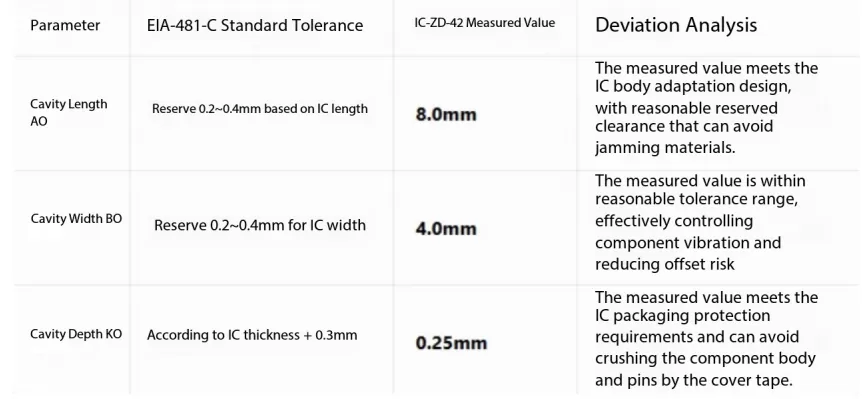
15282de1-e5b0-4a1d-9bfc-325ebc72c342.png

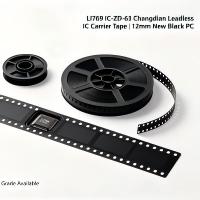
III. If the wrong material is chosen, even the strictest dimensional tolerances are of no use. The IC-ZD-42 primarily uses a modified PC (polycarbonate) substrate, whilst ultra-high-speed production lines employ a three-layer composite of ABS and PC. Its core performance directly determines whether it can withstand the rigours of high-speed assembly:

  1. Mechanical Properties: Tensile strength ≥65 MPa; no deformation or cracking during high-speed feeding at 8 m/s

  2. Dimensional Stability: Dimensional drift ≤0.01 mm under temperature variations between -20°C and 60°C

  3. ESD Protection: Modified with carbon powder or conductive particles; surface resistance stabilised at 10⁶–10⁹ Ω, compliant with ESD S20.20 standards

  4. Processing precision: Melting temperature 230–270°C, cavity consistency controlled within ±0.02 mm How to choose for different applications?

  • Conductive PC (black): 10⁴–10⁶ Ω, suitable for ESD-sensitive components such as high-frequency chips and precision operational amplifiers 

  • Anti-static PC (grey): 10⁷–10¹¹ Ω, suitable for standard small-sized ICs, offering better value for money 

  • ABS/PC composite: Combines toughness and rigidity, suitable for ultra-high-speed placement lines operating at ≥80,000 components per hour.

  • Warning: Low-temperature embrittlement, ESD attenuation and substrate impurities are three material defects that act as hidden killers, leading to supply issues later on. Pay close attention to these when selecting suppliers.

IV. Comprehensive Inspection System: Stopping Problems Before They Enter the Factory Many factories focus solely on dimensions and neglect the inspection process, resulting in numerous issues once production begins. A complete IC-ZD-42 inspection system must include these 5 steps:

  • Visual Inspection: Sampling 5% of each batch (no fewer than 5 reels), using a 30x magnifying glass and D65 light source to check for cracks, burrs and impurities

  • Dimensional Accuracy Inspection: 100% inspection of critical dimensions using a 3D imaging system, with a focus on controlling batch-to-batch variation in A0/B0/K0

  • ESD Testing: Measure one point at the start, middle and end of each roll; resistance deviation must be ≤1 order of magnitude

  • Mechanical Performance Testing: Tensile strength ≥65 MPa, peel force 0.2–1.5 N; no adhesive residue or tearing

  • Environmental Reliability Sampling: Select one roll per batch for high/low temperature and humidity/heat testing to ensure performance stability


V. Common Misconceptions Q&A: Avoid 80% of Pitfalls

  • Q1: What is the difference between IC-ZD-42 and standard 42mm carrier tape?

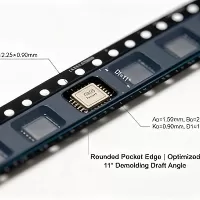
  • A: The key differences lie in dimensional accuracy and ESD stability. The IC-ZD-42 has a cavity tolerance of ±0.03 mm, with measured dimensions of A0=8.00 mm, B0=4.00 mm and K0=0.25 mm, and consistent ESD performance; Standard 42mm carrier tapes have a tolerance of ±0.1mm, with inconsistent ESD performance; mixing them can easily lead to pin deformation and ESD-related scrap.

  • Q2: Is a high IC placement rejection rate always down to the machine?

  • A: In 85% of cases, the root cause is carrier tape dimensional deviation! If B0 is too large (>4.20mm), components wobble excessively → rejection; If B0 is too small (<3.80mm), the pins are squeezed → deformation. Rather than repeatedly adjusting the machine, it is better to first check the consistency of the carrier tape’s A0/B0/K0 dimensions.

  • Q3: What should be prioritised when selecting a supplier?

  • A: Prioritise manufacturers with EIA-481 compliance + ISO9001 certification, equipped with in-line 3D imaging inspection. Focus on three key points: dimensional consistency, long-term ESD stability, and mass delivery capability.

  • Q4: How should carrier tapes be stored to prevent failure later on?

  • A: Store in a sealed container at 20–25°C and 40–60% RH, with a storage period not exceeding six months; once opened, use within 24 hours where possible; maintain a humidity level of ≥35% in the assembly workshop to minimise static build-up. Final Thoughts: Improving SMT yield has never been about applying ‘patches’ after the fact, but rather about preventing errors at the source. A small 42mm carrier tape embodies a holistic control logic spanning standards, materials and inspection. What carrier tape-related pitfalls have you encountered on the production line? Let’s discuss in the comments section!


Diam luctus nostra dapibus varius et semper semper rutrum ad risus
eros. Cursus libero viverra tempus netus diam vestibulum
David Backhum

GET FREE QUOTE

Please contact us.

We use cookie to improve your online experience. By continuing to browse this website, you agree to our use of cookie.

Cookies

Please read our Terms and Conditions and this Policy before accessing or using our Services. If you cannot agree with this Policy or the Terms and Conditions, please do not access or use our Services. If you are located in a jurisdiction outside the European Economic Area, by using our Services, you accept the Terms and Conditions and accept our privacy practices described in this Policy.
We may modify this Policy at any time, without prior notice, and changes may apply to any Personal Information we already hold about you, as well as any new Personal Information collected after the Policy is modified. If we make changes, we will notify you by revising the date at the top of this Policy. We will provide you with advanced notice if we make any material changes to how we collect, use or disclose your Personal Information that impact your rights under this Policy. If you are located in a jurisdiction other than the European Economic Area, the United Kingdom or Switzerland (collectively “European Countries”), your continued access or use of our Services after receiving the notice of changes, constitutes your acknowledgement that you accept the updated Policy. In addition, we may provide you with real time disclosures or additional information about the Personal Information handling practices of specific parts of our Services. Such notices may supplement this Policy or provide you with additional choices about how we process your Personal Information.


Cookies

Cookies are small text files stored on your device when you access most Websites on the internet or open certain emails. Among other things, Cookies allow a Website to recognize your device and remember if you've been to the Website before. Examples of information collected by Cookies include your browser type and the address of the Website from which you arrived at our Website as well as IP address and clickstream behavior (that is the pages you view and the links you click).We use the term cookie to refer to Cookies and technologies that perform a similar function to Cookies (e.g., tags, pixels, web beacons, etc.). Cookies can be read by the originating Website on each subsequent visit and by any other Website that recognizes the cookie. The Website uses Cookies in order to make the Website easier to use, to support a better user experience, including the provision of information and functionality to you, as well as to provide us with information about how the Website is used so that we can make sure it is as up to date, relevant, and error free as we can. Cookies on the Website We use Cookies to personalize your experience when you visit the Site, uniquely identify your computer for security purposes, and enable us and our third-party service providers to serve ads on our behalf across the internet.

We classify Cookies in the following categories:
 ●  Strictly Necessary Cookies
 ●  Performance Cookies
 ●  Functional Cookies
 ●  Targeting Cookies


Cookie List
A cookie is a small piece of data (text file) that a website – when visited by a user – asks your browser to store on your device in order to remember information about you, such as your language preference or login information. Those cookies are set by us and called first-party cookies. We also use third-party cookies – which are cookies from a domain different than the domain of the website you are visiting – for our advertising and marketing efforts. More specifically, we use cookies and other tracking technologies for the following purposes:

Strictly Necessary Cookies
These cookies are necessary for the website to function and cannot be switched off in our systems. They are usually only set in response to actions made by you which amount to a request for services, such as setting your privacy preferences, logging in or filling in forms. You can set your browser to block or alert you about these cookies, but some parts of the site will not then work. These cookies do not store any personally identifiable information.

Functional Cookies
These cookies enable the website to provide enhanced functionality and personalisation. They may be set by us or by third party providers whose services we have added to our pages. If you do not allow these cookies then some or all of these services may not function properly.

Performance Cookies
These cookies allow us to count visits and traffic sources so we can measure and improve the performance of our site. They help us to know which pages are the most and least popular and see how visitors move around the site. All information these cookies collect is aggregated and therefore anonymous. If you do not allow these cookies we will not know when you have visited our site, and will not be able to monitor its performance.

Targeting Cookies
These cookies may be set through our site by our advertising partners. They may be used by those companies to build a profile of your interests and show you relevant adverts on other sites. They do not store directly personal information, but are based on uniquely identifying your browser and internet device. If you do not allow these cookies, you will experience less targeted advertising.

How To Turn Off Cookies
You can choose to restrict or block Cookies through your browser settings at any time. Please note that certain Cookies may be set as soon as you visit the Website, but you can remove them using your browser settings. However, please be aware that restricting or blocking Cookies set on the Website may impact the functionality or performance of the Website or prevent you from using certain services provided through the Website. It will also affect our ability to update the Website to cater for user preferences and improve performance. Cookies within Mobile Applications

We only use Strictly Necessary Cookies on our mobile applications. These Cookies are critical to the functionality of our applications, so if you block or delete these Cookies you may not be able to use the application. These Cookies are not shared with any other application on your mobile device. We never use the Cookies from the mobile application to store personal information about you.

If you have questions or concerns regarding any information in this Privacy Policy, please contact us by email at . You can also contact us via our customer service at our Site.