Xiang'an Industrial Park Xiamen Torch High-tech Zone


Company News
Why Is Black the Preferred Color for High-End Chip Packaging? Haidelong DFN Carrier Tapes Provide the Answer
When we take apart a high-end smartphone, an automotive ECU, or a smartwatch, one type of package stands out on the exposed PCBs: the DFN (Dual-Flange No-Lead) package. It is flat and square, lying flush against the board surface with no protruding pins, resembling a delicate black tile embedded in the circuit board. And the carrier tape holding these DFN components is often black as well. Some might ask: Wouldn’t a transparent carrier tape make it easier to inspect? Why use black specifically? Today, Haidelong will start with DFN carrier tapes to discuss the technical logic behind that “deep black” and share our real-world test results. DFN packaging is widely used in power management chips, memory chips, MOSFETs, and other devices because of its small size, excellent heat dissipation, and low parasitic parameters. However, this also places higher demands on the carrier tape. Unlike ordinary discrete components, DFN devices are extremely sensitive to static electricity. While transparent PC material is aesthetically pleasing and facilitates optical inspection, black modified PC has a natural advantage in terms of anti-static and light-blocking performance. The black color used in Haidelong’s DFN carrier tapes is not achieved through simple dyeing. Instead, by adding specific proportions of anti-static masterbatch and carbon black, the surface resistivity of the carrier tape is stabilized between 10⁴ and 10⁶ Ω. This allows for rapid dissipation of static electricity while effectively shielding certain light-sensitive components from external light. We fully understand that dimensional accuracy is the lifeline of DFN packaging. The following are actual test data for Haidelong’s DFN carrier tape, clearly comparing it to the international EIA-481 standard: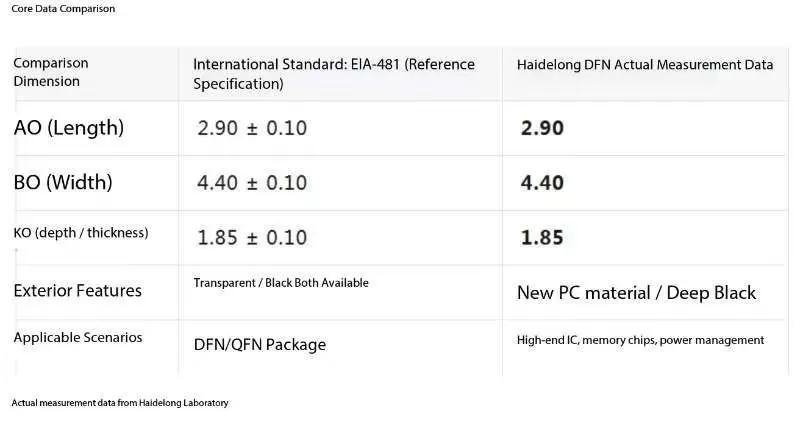
Test data from Haidelong’s laboratory Some may worry: Will black carrier tape affect recognition by AOI (Automated Optical Inspection) equipment? This is a very practical concern. The answer is: It depends on the equipment. Mainstream AOI equipment brands (such as Omron, Kao-Ying, and Delux) all support adjustment of light source angles and exposure parameters, making it entirely possible to identify components inside a black carrier. In fact, many high-end FPC (flexible printed circuit) factories have been using Haidelong’s black carrier tape extensively for years. If you have concerns regarding the inspection process, please feel free to contact our technical team to request a sample for testing. Another frequently asked question is: Does black carrier tape have a longer lead time? From a production perspective, the difference between black and transparent tape lies solely in the masterbatch formulation; the molding and slitting processes are identical. As long as there is sufficient stock of black PC material, lead times are essentially the same. For this DFN model, Haidelong employs a “New PC” formulation, which modifies the base polycarbonate to enhance antistatic properties and surface hardness while ensuring uniform dispersion of the black masterbatch. The visible differences are: the black color is purer, the surface is smoother, and there is no color variation between batches. With over 600 proprietary molds and fully automated production lines capable of molding 9 strands of tape in a single pass, we ensure consistency in every inch of carrier tape during mass production. This is how HATRO lives up to the concept of “precision” every day. Our Commitment Founded in Xiamen, Haidelong Electronics has been deeply rooted in the carrier tape industry for over two decades. From material formulation to mold development, and from particle molding to slitting and packaging, we maintain full in-house control throughout the entire process. Every batch of DFN carrier tape that leaves our factory undergoes rigorous inspection using a MOTUTOYO 3D non-contact infrared imaging inspection system. We may not claim perfection, but we can confidently say: every roll is worthy of your trust.
Q&A: Frequently Asked Questions
Q1: Will black carrier tape affect optical inspection?
A: This is the most frequently asked question about black DFN carrier tape. In fact, mainstream AOI equipment can fully identify components within black cavities by adjusting the light source angle and exposure parameters. If your inspection equipment is older, please feel free to contact us to send samples for testing. Many users ultimately find that the anti-static and light-shielding advantages of black carrier tape far outweigh the minor adjustment costs during the inspection process.
Q2: The DFN K0 depth is 1.85mm. Isn’t that too deep for a 0.90mm-thick chip?
A: The carrier cavity depth must allow sufficient space for the pick-and-place nozzle to pick up the component. 1.85mm is the standard depth designed for DFN packages with a thickness of approximately 0.80–1.20mm. If your components have special thickness requirements, Haidelong maintains a library of over 600 molds and can customize non-standard solutions for you.
Q3: What is the difference between “New PC” and standard PC?
A: The “New PC” used in Haidelong’s DFN carrier tapes is a modified version of standard polycarbonate. It primarily enhances antistatic properties and surface hardness while ensuring uniform dispersion of black masterbatch. Visually, the difference is evident: the black color is purer, the surface is smoother, and there is no color variation between batches.
Q4: Can DFN carrier tapes be used for QFN packages?
A: DFN and QF
Diam luctus nostra dapibus varius et semper semper
rutrum ad risus
eros. Cursus libero viverra tempus netus diam vestibulum


GET FREE QUOTE
Please contact us.